


Section 1: Approaches to Applying for Jobs
Before we begin...
In this section, we present advice shared by survey respondents concerning how to review career options and locate job opportunities. However, it is worth first noting that the academic job market is competitive and the challenges of entering and remaining in academia are not experienced equally[1], and not all of the advice shared here may fit your situation. Academia can also cause many of us to doubt ourselves and our worth, and thinking about career planning (especially amidst precarity) can be deeply stressful and exhausting. As you start searching for employment, try to remember that you are already a skilled and accomplished person. You may hold a PhD (or are nearing the completion of one) and you likely have a wide range of skills, experiences and accomplishments.
[1] Sectoral insecurity and academic precarity impact ‘freedoms to choose’ in uneven ways that necessitate intersectional attention.
Contents
1.1 Tips for considering your options and finding job opportunities
Academic careers
Careers beyond the academy
1.2 Tips for seeking feedback and support

Tips for considering your options and finding job opportunities
Academic Careers
If you are interested in pursuing or continuing an academic career, there are several things you can do to assess your options, depending on your position and career stage.
Looking for Opportunities
Regularly check relevant websites, email listservs, and online networks for job opportunities (e.g. www.jobs.ac.uk - try using both general and specific search terms, Times Higher Education UniJobs, sign up to emails from relevant Royal Geographical Society Research Groups and wider networks, Critical Geography Forum is also a UK-based email listserv where users often share employment opportunities).
Connecting with Your Research Group Lead or Head of Research
If you are already working within an institution and are interested in extending your employment by applying for external fellowships based on an independent research project, why not ask for a meeting with either the head of your research group, or your department/school’s head of research? You can ask them for advice on funding schemes, about the forms of support available for developing your proposals, and whether your institution holds any examples of successful past applications. Remember that any application that you submit, successful or otherwise, can be mentioned in job applications as evidence of engagement with the funding process and demonstrate that you are actively pursuing your own independent research.
Exploring Redeployment and Internal Opportunities
If you are already employed by an institution and have a line manager, it is worth reaching out to them to ask for information about any relevant institutional policies on redeployment and/or potential opportunities for continued employment. You could also try reaching out to your head of department/school. While not always possible, universities have a duty to support staff whose contracts are ending in finding suitable alternative employment within the institution. There may also be employment opportunities within the university but outside of research or teaching.
Exploring Diverse Academic Career Paths and Experiences
There are many pathways to a permanent academic contract. For example, some geographers in our survey entered a permanent position following their PhD. More often, however, colleagues first completed one or more research fellowships or teaching-focused positions. Others entered academia following a period of employment in a non-academic industry. A common observation across the survey was that speaking to colleagues from across career stages about their academic trajectories was a useful experience.
Seeking Mentor Support
If you are already at an institution and have a mentor, make sure you request time to talk to them about your next steps, including career aspirations and options or any research projects you may be interested in developing. If you don’t have a mentor, consider reaching out to a trusted academic friend or colleague (if you have one) for informal mentorship, asking to discuss the topics above. Mentors may be able to offer forms of support beyond your institution’s career support and/or staff training programmes. This may include support in skills such as academic CV writing and preparing postdoctoral fellowship applications. Try to be as direct as possible with them about your situation (e.g. visa restrictions, geographical restrictions). If you are thinking about developing a fellowship bid, it is similarly worth speaking to mentors or trusted academic peers about available funding schemes in your field, possible co-investigators, and for input on your proposal drafts.
If you are still in the process of completing your PhD, your supervisor may be willing to provide mentorship. You could initiate a discussion with them about when the right time might be to start applying for jobs, how you might approach this, and for which kinds of roles or positions. Some universities also offer free coaching services which may provide similar forms of support.
Knowing Your Rights
If you are a member of the University College Union (UCU) and have been on successive fixed-term contracts at your institution, consider consulting and/or seeking Union guidance related to successive fixed term contracts and permanency. The UCU also provides a range of guidance around ‘knowing your rights’ and the ‘ending of a fixed-term contract’. If you are a UCU member, it may also be worth contacting your local UCU branch to determine if they have any hardship, solidarity, or bridging funds that may offer some temporary financial support whilst job searching. Further UCU resources can be found at the end of this toolkit.
Careers Beyond the Academy
It might not appear this way, but many geographers leave academia and lead successful and fulfilling careers. Whilst recent decades have seen considerable growth in the number of people receiving PhDs, the number of academic jobs has not risen to accommodate this growth. The skills developed through PhDs are in demand by employers, but we rarely receive sufficient support to think about how our skills and experiences may be translated into opportunities in other sectors. There is also a wider stigma around pursuing alternative career paths. As one respondent noted, we need to work towards “creating a culture where leaving academia is not a failure”. While the wider UK job market has its own challenges, especially for marginalised groups and visa holders, it may be worth exploring non-academic career pathways to see what might be available.
Searching for Non-Academic Jobs
Searching online for resources using terms such as ‘alt ac’ (alternative academic) can help in highlighting professional roles that utilise research skills both in and beyond the academy. Alongside useful guidance on understanding, preparing, getting started and ‘going alt-ac’, examples of active and supportive ‘alt ac’ communities include the ‘AltAc Careers - Leaving Academia’ Facebook group. Consider also consulting the Royal Geographical Society’s career resources related to ‘using Geography’ beyond the academy and developing your career. In addition to advertising UK-based academic roles, jobs.ac.uk also includes listings for jobs across a range of sectors.
Seeking Support From Your Institution
Most universities have an active career service division. If you are already based in an institution, have a look at what they offer and consider arranging a meeting with a career advisor. You can also reach out and ask if they offer guidance on writing non-academic CVs and preparing for interviews. Some institutions may also offer longer-term support for former students and staff, meaning it may be possible to draw on resources from previous institutions, if needed.
Seeking Inspiration from Peers and Mentors
While many senior academics have limited industry experience, they may still have useful ideas or contacts related to alt-ac career paths relevant to your area of research. If you have friends, colleagues, or former colleagues who occupy senior roles, you could ask them about the career paths of previous PhD candidates or postdocs, what they consider to be particularly relevant industries or roles, as well as support in developing a list/record of the kinds of transferable skills you have accrued on your academic journey.
Tips for Seeking Feedback and Support
Our survey shows that there is great willingness in our community to support early career academics and people experiencing precarity. This section contains suggestions for some of the different kinds of support you might be able to seek out from your community - as well as suggestions for how to return favours in kind if you have capacity to do so.
Sharing Resources
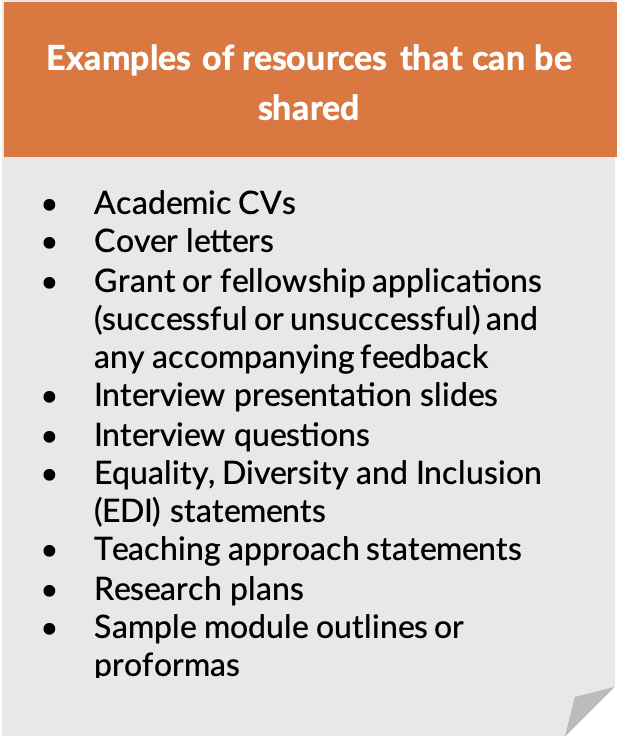
Sharing application material with people you trust can be incredibly constructive. Consider asking mentors, people on more secure contracts, or peers who are less likely to be applying for the same positions as yourself for examples of their successful applications. Even examples from people with a different profile or specialism can be helpful to give you a sense of structure, tone, how to promote yourself, and the kinds of themes and examples to include. Remember that academic career paths and profiles can look very different, so try not to compare yourself unfavourably to your peers.
CV and Cover Letter Writing
‘Selling yourself’ in CVs and cover letters can be challenging and even awkward. In terms of structure, you can consult online resources which provide template suggestions (see examples listed on the right). You also need to present yourself with a degree of confidence and with less modesty than you might normally do. Applying for different positions – in particular, postdoctoral positions - also often involves repeatedly reinventing and projecting different academic identities that may feel strange and uncomfortable.
Feedback from peers and mentors can play a crucial role here. If you can, ask for feedback on things like tone and whether your claims appear fully evidenced and convincing. Talk about how to position yourself for the job you’re applying for and whether your application material responds to the job criteria effectively. You might also discuss how you can evidence any statements you make in your cover letter.
Examples of CV and Cover Letter Templates
Keep a Record of Your Activities
To ease the process of updating your CV and writing strong cover letters, keep a live document where you proactively and consistently record your activities and reflect on them. These may include teaching (with details of modules and responsibilities), internal and external seminars and workshops, conferences, publications, blog posts, administrative responsibilities, committee memberships, awards or prizes, impact work and other forms of engagement and activity. Save any correspondence or feedback (e.g. module evaluations, referee reports) that speaks to the quality of your work or its impact - this can be cited in cover letters as direct evidence to support your applications.
Supporting Referees to Write Strong Letters of Recommendation
Applications often require applicants to list one or several ‘referees’, namely an individual who can comment on you in a professional capacity. Referees are often only approached when applicants reach the interview stage or are offered a role. Referees play an important role in the application process. If you have a mentor, supervisor, or trusted colleague, ask them for their input on who would make a good referee for your application. In some cases, they may be well-placed to act as a referee, though the most suitable referee may differ depending on what kind of opportunity you are applying for. Make sure your referees have all the information they need to write a letter of recommendation that makes it clear why you are the best candidate for the job (including details about the position you are applying for, and information on your relevant experience and skills). Send them your CV, cover letter and consider highlighting some concrete points that you think the referee would be well positioned to communicate and speak to.
Mock Interviews and Presentations
Making it to the interview stage is a significant accomplishment. Remember that you have been shortlisted because you are a strong candidate (and because you are already considered employable and able to do that job). This means you can afford to be confident in yourself! Seek out opportunities for doing a mock job presentation and/or interview to get some feedback on your performance. You can ask a supervisor or a mentor, or if you are part of an institution already, check what is on offer from the career service. If your interview involves a presentation, it can be a good idea to practice in front of peers or mentors, too.
Useful Resources for Interviews and Presentations
- General guidance on academic interviews, including sample interview questions
- 10 Top Tips for Interview Presentations (job.ac.uk)
- Pointers on academic interview presentations (RGS)
Learning from Past Interviews
If you don’t get offered a job, it may be because of factors outside of your control (departmental priorities, candidates with more experience in specific areas), so try not to beat yourself up! Employers in academia typically interview 3-6 candidates for each position, and statistically most people who interview don’t get the job despite being highly qualified. Try to remember that each interview is a learning opportunity. Whilst it may be the last thing you want to hear after an unsuccessful job interview, ask for feedback from the person leading the interview and try to listen to the positives as well as areas for improvement. Keeping a record of the questions you were asked during your interviews and job presentations can also help you when preparing for the next one.
Wellbeing and Community Support
The survey showed that applying for jobs - or even thinking about applying for jobs - can be stressful and may feel all-consuming – particularly because of the effort of having to place yourself within the advertised role and location. Try to be aware of and protect your mental health throughout this process. Many respondents said that talking to peers and mentors about their experiences was helpful, but this should never be a substitute for professional forms of mental health support.
Respondent A
"My colleagues have been proactive in looking at opportunities which can support my personal career development"
Employment status: Fixed Term Contract
Age: Prefer not to say
Gender: Female
Respondent B
"My colleagues within my research team take the time to listen, to support me and my colleagues, e.g. through regular meetings where we discuss wellbeing and work issues, and through positive feedback and attempts to find new contracts for me for after this one ends"
Employment status: Fixed Term Contract
Age: 30-39
Gender: Female
Respondent C
"Colleagues have regularly given positive feedback and expressed their desire to keep me on permanently, and when by chance the opportunity of a short term extension came up this was advertised to me"
Employment status: Fixed Term Contract
Age: Under 30
Gender: Female
Create Your Own Website With Webador